Galileo Galilei

Galileo Galilei features a rondel action selection mechanism where one half of the rondel is fixed and the other is a sliding pieces that cycle back to the bottom, similar to how the action cards work from Ark Nova.
Each turn you'll move your telescope 1 to 3 spaces along the track in order take actions. You'll be gaining dice in order to spend them to observe constellations and planets. Typically constellations are cheaper to discover, giving a few points with other bonuses, while the major objects will let you take the card and add to your growing library, which adds a new column of bonuses/penalties. To help pay for things, especially as the cost rises for later card discoveries, you can use comments which will help discount the cost as well as eventually earning you one time bonuses on Book of Comets on the main board.
The game also features modular randomized objectives that players are racing to claim. You'll be going up tracks, which are also randomized with benifits and/or penalties whenever you take a lecture action. And the other main mechanic is the inquisition and reputation. If you have persuaded any inquisitors on your board, you'll have to deal with an interrogation as part of your clean up phase. This is tough because inquisitors will often cause you to take negative reputation, so managing when to persuade them in order to gain or at least mitigate the loss of reputation is really important for end game scoring.
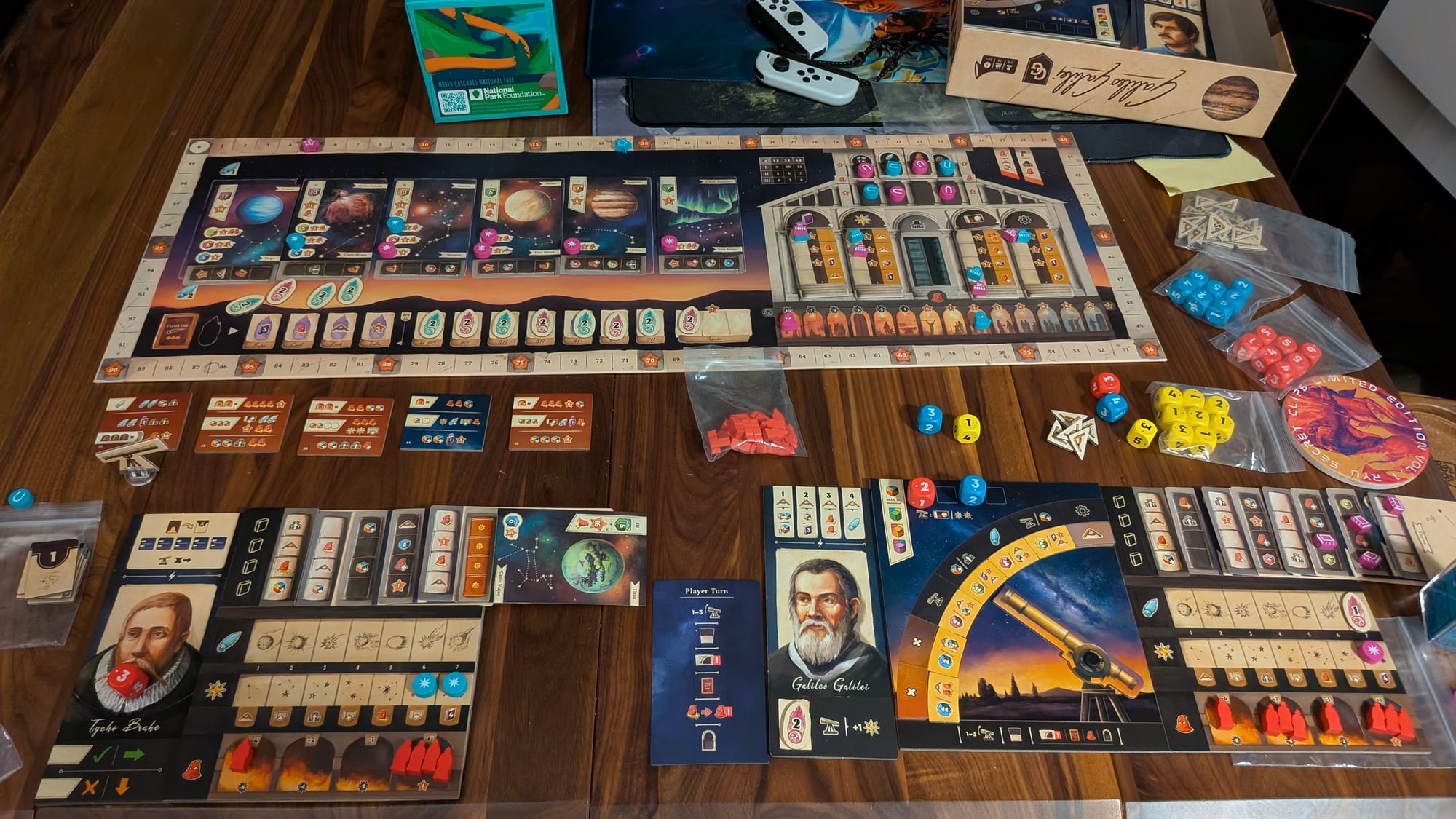
Overall, I find the game to be an enjoyable euro style game. The actions are interesting and quite puzzley. Playing solo is very straight forward and easy to operate. I'd like to see if next time I can better manage my inquisitors.





Member discussion