Galactic Cruise
It's interesting how my relationship with heavy board games has changed over time. Years ago I was introduced to more modern board games by some friends in Colorado. This was back when say Destiny was new, I was much more focused on video games and most of my exposure to modern board games were just the social deduction and light party games I had played in college. Stuff like The Resistance, Coup and Munchkin. All of a sudden, I was shown these super complicated games: Spirit Island, Gloomhaven, and Kingdom Death: Monster. Needless to say, I very much wasn't ready for those kinds of experiences and it wasn't until I started seeking out heavier games myself that I found what does and doesn't work for me. Anachrony was my first chosen heavy game and one that I fully enjoyed, especially with how it translated the mechanics of taking debt with the theme of time travel and borrowing from the future.
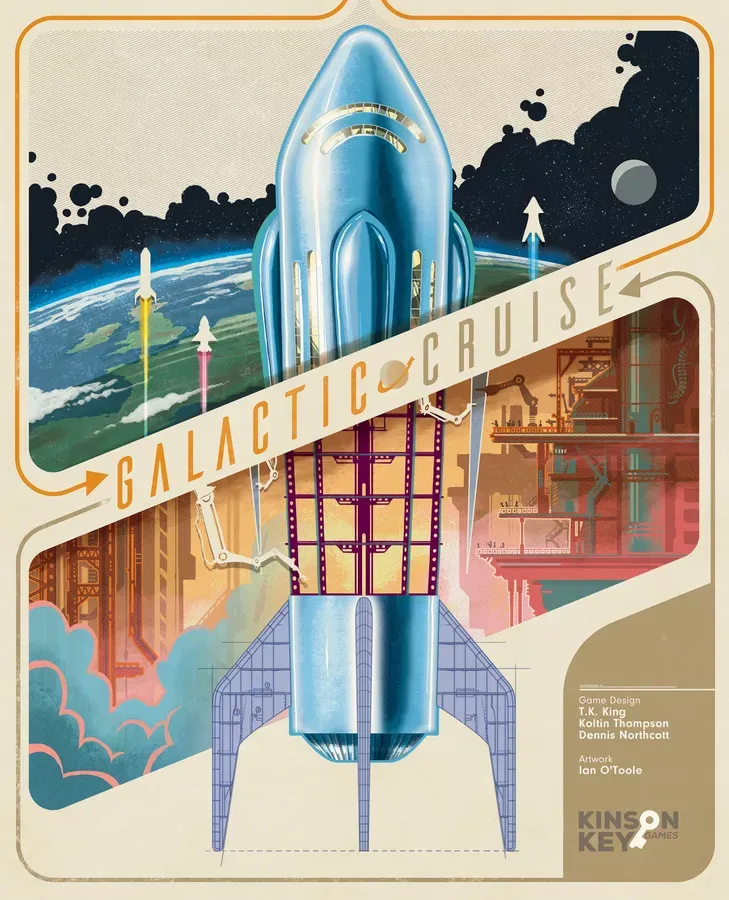
In that way, Galactic Cruise is very much a success for my heavy euro game experience. Here, players are all working for this company that centers around luxury cruise lines that fly through outer space. You can sort of think of players as different teams within the company, operating their own fleet of space ships that they build and improve and send off with passengers. The art and iconography are all done by the talented Ian O'Toole, so it was very easy to be drawn in by the cover alone. But the premise is is super interesting to me, it centers more on a more hopeful and bright future where people can relax and enjoy space travel. And me being someone who loves the theme of science fiction, this game held my interest.
On weight and complexity
Weight and complexity is such an interesting thing to gauge for a board game, honestly, I do feel like it's highly subjective too. For instance, my previous example of Anachrony is rated a 4 out of 5 complexity on BoardGameGeek, currently 62.6% of 1114 community user votes gave it that 4. I do agree it's justified, it is a complex game, but I feel like that complexity happens upfront with the learning part of it compared to playing it feels pretty smooth and things make sense. Even BGG's page defining weight states that "For different people weight means different things..." and even within that I think people will also weigh things with different importance in judging how complex a game is to them.
Probably one contrasting example of this is when I was being taught On Mars, another heavy euro board game with a sci-fi theme and striking cover art by Ian O'Toole. Except this time the designer was Vital Lacerda, who is well known for his super heavy designs that are kind of love-it-or-hate-it. However, I did my research, watched videos, and felt resolute in at least trying it out. I had a physical copy but I learned through some friends online during the pandemic and one of them knew and taught the game. Unfortunately, that experience was completely miserable to me: I felt like I was drowning in a game where I had no idea how to do anything, let alone know what I should be doing, and it I felt trapped for hours in a game I was not enjoying. It was so bad that I sold off my copy of On Mars because I knew I wouldn't play it. I liked the idea behind it, but it just didn't work for me.

That's not to say I don't enjoy heavy games, before that learning session with On Mars, I had actually gotten to learn and enjoy Kingdom Death: Monster and owned Anachrony. And even now, I do like some of Lacerda's games, namely Kanban EV and Inventions: Evolution of Ideas. But there's definitely a threshold of complexity that I've come to learn about myself that I need to exercise when evaluating a possible heavy-complexity board game.
Back to the drawing board
So let's refocus back onto this board game, Galactic Cruise. Yes, it's a complex board game, but kind of like I mentioned with Anachrony I feel like that complexity is mostly up front. Otherwise, at least from my experience, play and execution start to make sense due to the theme. It's effectively a worker placement game with 6 spots, and each of those spots are associated with 2 actions - making it so that there's only 12 actions to learn and you're good to go. Some of them are really simple: your standard get resources, get blueprints, build parts, research technology, and others. And some are specific but thematic to the game: presell tickets to people for cruises, schedule a cruise, these all make sense within the context of the game's theme.
In that way, I think the theme helps with teaching this game. Yeah, of course, you need to have a ship built out to launch. And what does a cruise need but people to be on it, so you need to spend advertising to get people onto your cruise. What else does a cruise need, resources: fuel, food, oxygen. The theme helps drive player actions intuitively for what would otherwise just be generic game mechanisms and actions.
Smarter worker placement
And it does so without adding needless friction. For example, in worker placement games typically when a player places a worker it blocks others from taking that spot until the worker is taken back or till the next round. This forces players to consider opportunity cost and prioritization, "will this spot be available for my next turn, do I need to do this now or possibly risk giving it up" kind of thought process. But that wouldn't make sense in Galactic Cruise since you're all working for the same company - its competitive but not cutthroat. So here, instead, if someone is in a spot you want to go to, you just bump them off. No one prevents anyone from taking actions, the spot is always available, however the person whose worker is bumped gets a little income bonus for being bumped out early.
It's such a good twist in terms of positive interaction turned to a strategic way. I know some people lament that games are too focused on positive interactions only, and I can understand that viewpoint where if everything is a benefit then where's the point of contention and difficulty. I think the way its handled here in Galactic Cruise is impressive that a positive interaction can be weaponized. Sure, you could go to a spot that is blocked, but if you do that not only do they get a benefit but they also delay having to recall all their workers - is that spot really worth it? Will I benefit more from it? It's such a smart way of having player interaction.
Our engines are taking flight
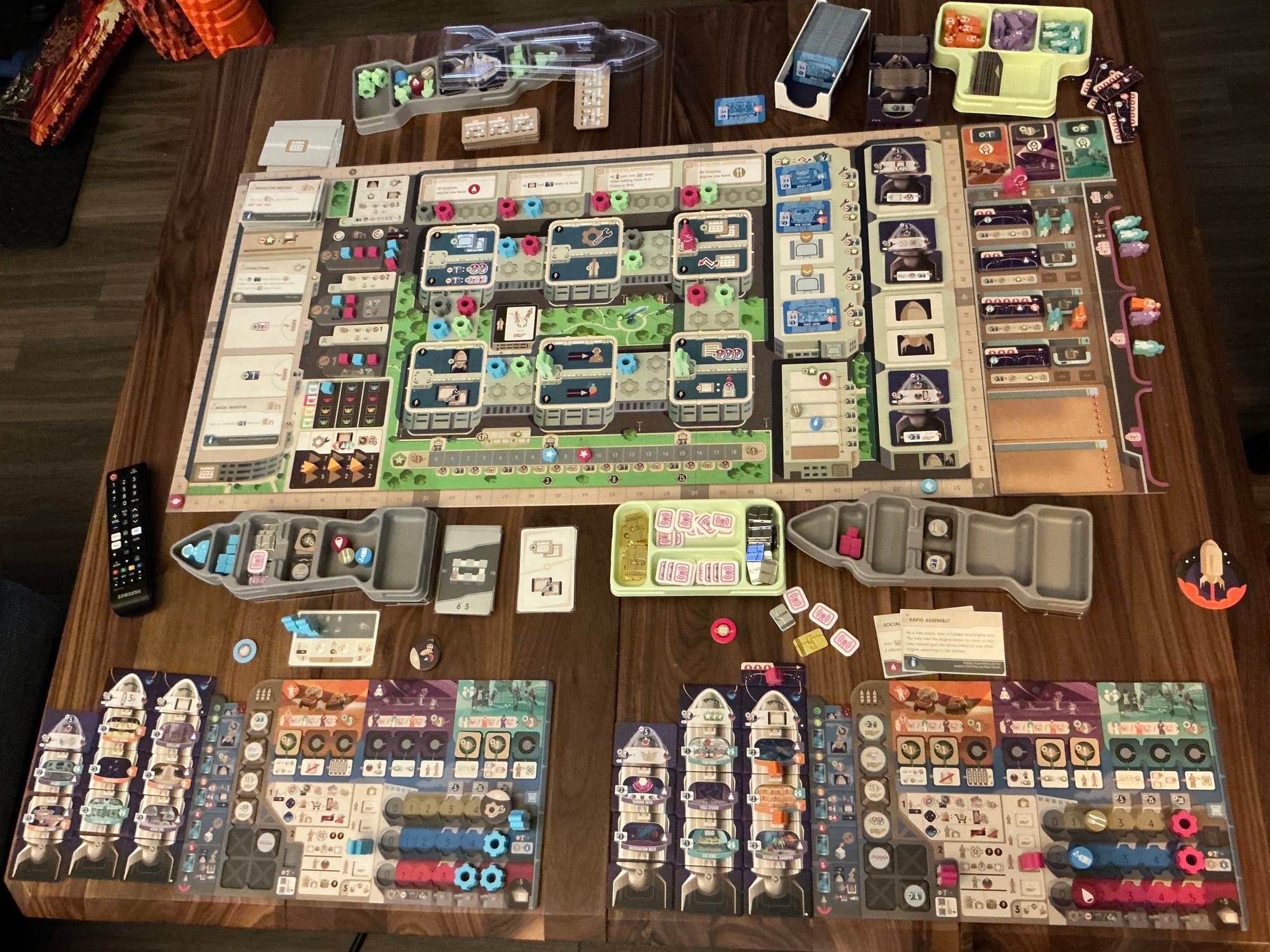
So most of the game is worker placement, but what of the space ships that people are taking cruises on? Well, these are basically little mini engines that you're building out and ideally will send out multiple times to recur benefits from. This comes from the flight plan you assign it, the types of guests that will be on the ship, the planets they'll be visiting for excursions. And all of that progresses at the start of your turn once you send a ship on their flight.
It's a really interesting analogy how you and your team of workers are still on the ground, managing and improving things while the ship flies in space. One the flight plan is in place, its just doing its thing, giving you benefits at times, and pushing you to that end goal of gaining points for winning. Though, it does feel odd that although the game has 3 rounds, by the end of the 1st one you're effectively half way through the game because by then people will start accelerating the game's end by sending out ships repeatedly.
Arriving back home
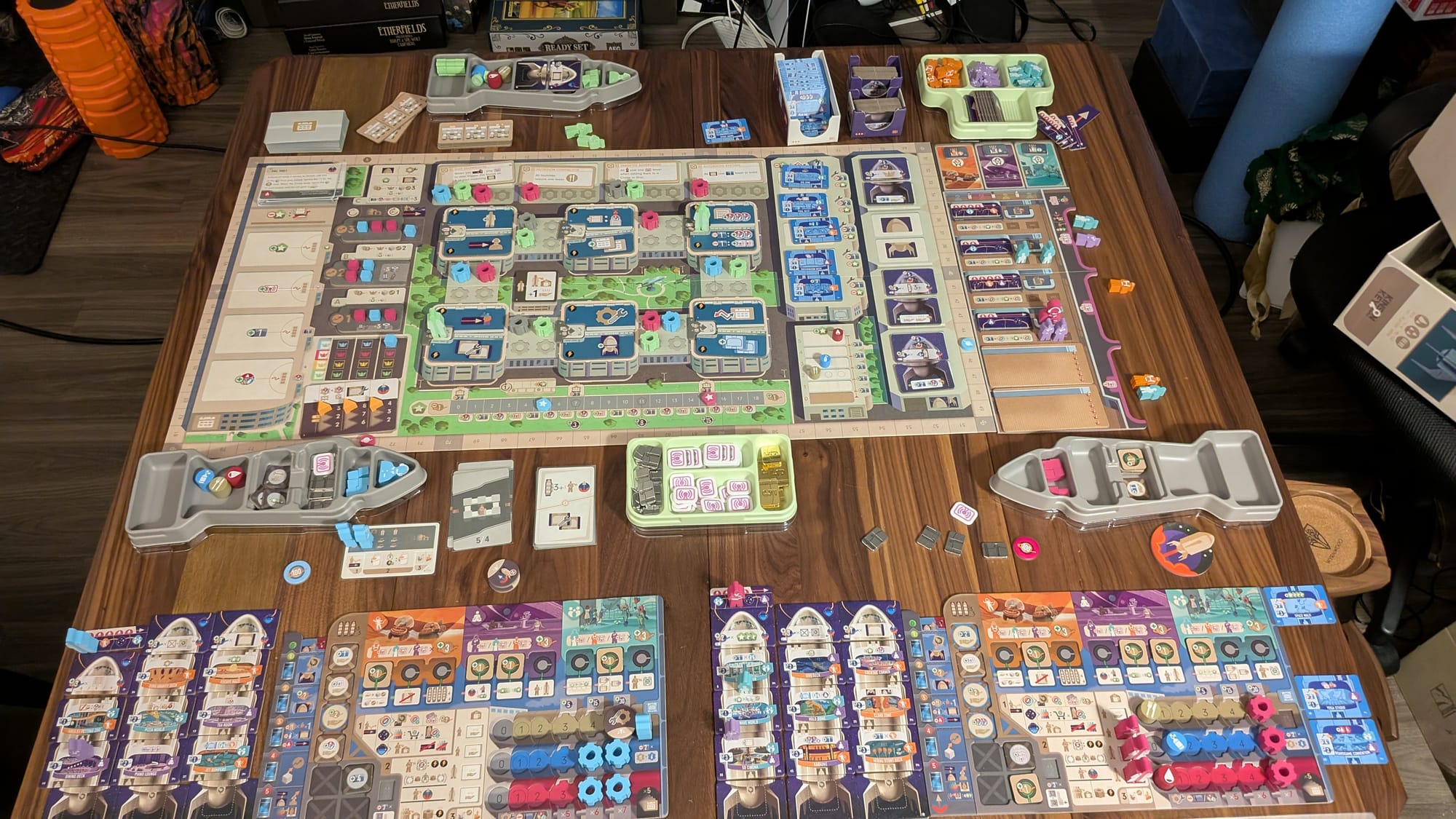
Most of my games of Galactic Cruise have been solo, but that's okay - the solo mode plays smoothly and it's enjoyable to play it multi-handed solo as well. There are aspects of the expansions that are hit or miss, I'm not a fan of the "harder" ship building and aligning guest rooms but I do like stuff like the starting upgrades and more. It's a game that impressed me greatly and I can see it rising in my personal top games.



Member discussion