Bebop
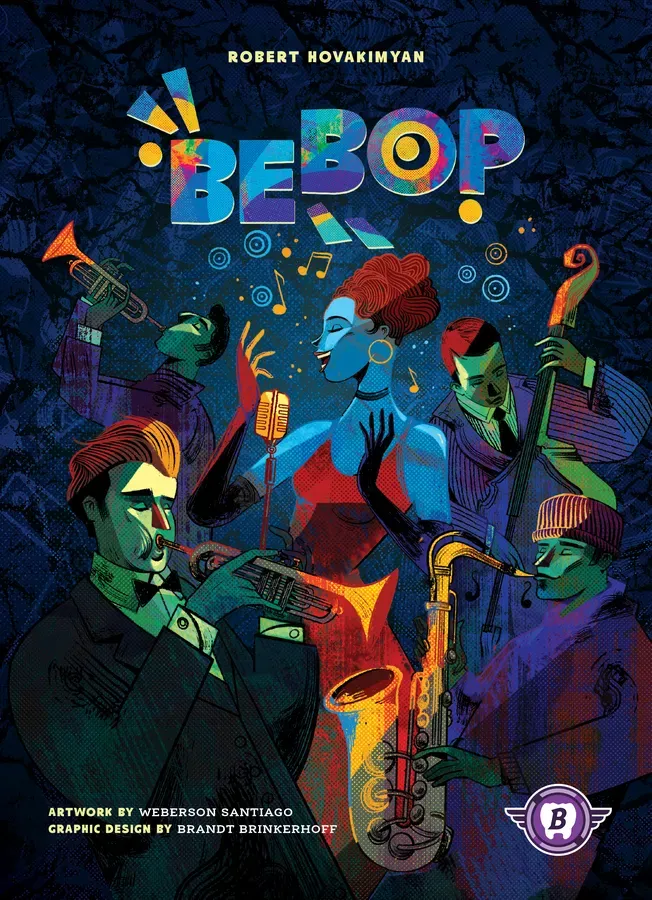
Bebop is one of a trio of Jazz-themed games that launched from Bitewing's crowdfunding campaign and was really taken by the cool art for the games. While I was more interested in Shuffle and Swing for its Euro dice placement, I figured it'd still be a good deal getting the whole bundle.
The concept for Bebop is that you're buying seats at a Jazz Festival, performers have multiple spread out stages and its your job to reserve seats and assign them to people (represented as dice) who have a favorite instrument as well as a family. There's five colors, representing different families, and you're wanting to group them adjacent as much as possible. The flip side is that you also want to place certain favorite instruments of that person (the die face) next to the same performing artist on the board.
It's a tough balancing act of claiming the right spots and placing dice. Usually on a turn you'll be doing one or the other for your action, so figuring out when to claim a tile versus when to place a dice is the timing puzzle of the game. The game forces progression though by having a limit of 3 booked hex spots on the board, so you can't just keep grabing seats with no one in them. There's also 5 special action hexes you can use, one even allowing you to replace an empty claimed seat of an opponent, so it's like a one-time take that action.
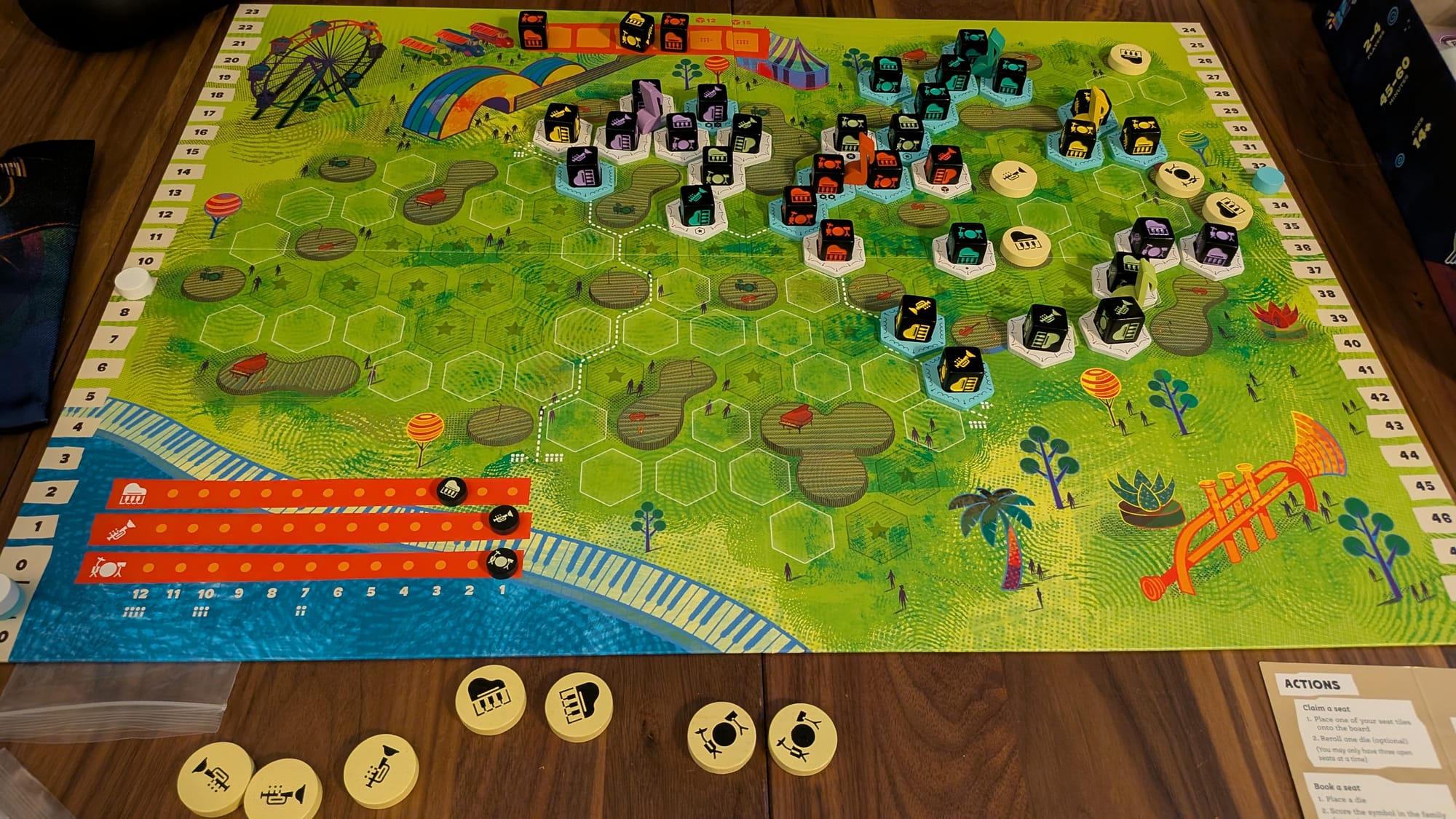
Probably the hardest thing to wrap your head around is the fact that family groups are shared between player seats, though majority will matter for scoring purposes. The game also pushes a race to have performances happen early as they score more for being the early performance versus later. At the end, the largest grouping of each of the 5 family scores and that will go to whoever has majority of each instrument with the points based on how many performances you claimed for that instrument.
If that sounds confusing, it kind of is when you're learning the game for the first time. In some ways scoring feels a little obscure until you go through the process of having a performance happen. It also feels odd to contribute to the same family with other players, like a growing Area Majority puzzle that expands through play. From my one play, my main takeaway was that it doesn't work out too well if you just focus on making your own little area. In some ways, it can be a better move to contribute to another family chain versus building it all on your own.
In my opinion, the deluxe version feels like it should have been the default, with the wooden performance chips, player claim pieces and bits. Though, I think one drawback is the choice of colors, in certain lighting seeing the difference between the blue and the green can be a little difficult. I think it would have been nice for some kind of family symbol to be on the die itself as well, to help differentiate between die colors. But at the same time, I can also understand that could make things "look" a little bit too busy when the board state needs to be comprehended at a glance.

Unfortunately, this isn't a game that can be played solo, at least not in a sensible two-handed play way. And from its design, I doubt a reasonable solo mode could be made since you can kind of freely place tiles anywhere there's open space. You couuld try to come up with strategic rules but then it's kind of predictable what the "AI" will do. Maybe that's a design challenge in of itself. This is a highly interactive game and requires active strategic thought when playing due to its open ended and organic play nature.
I think this is something I'd want to try again, moreso with other people, and see how they think. I applaud it for executing on being a very clean design with depth to it.


Member discussion